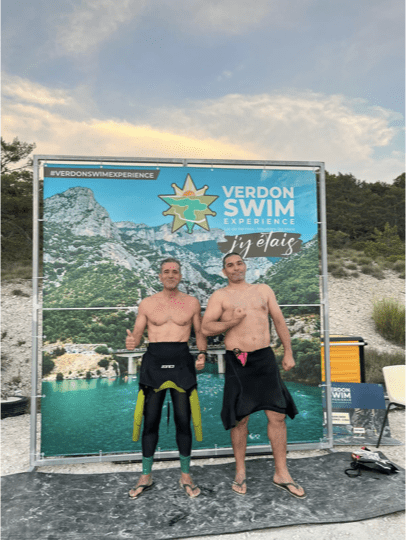
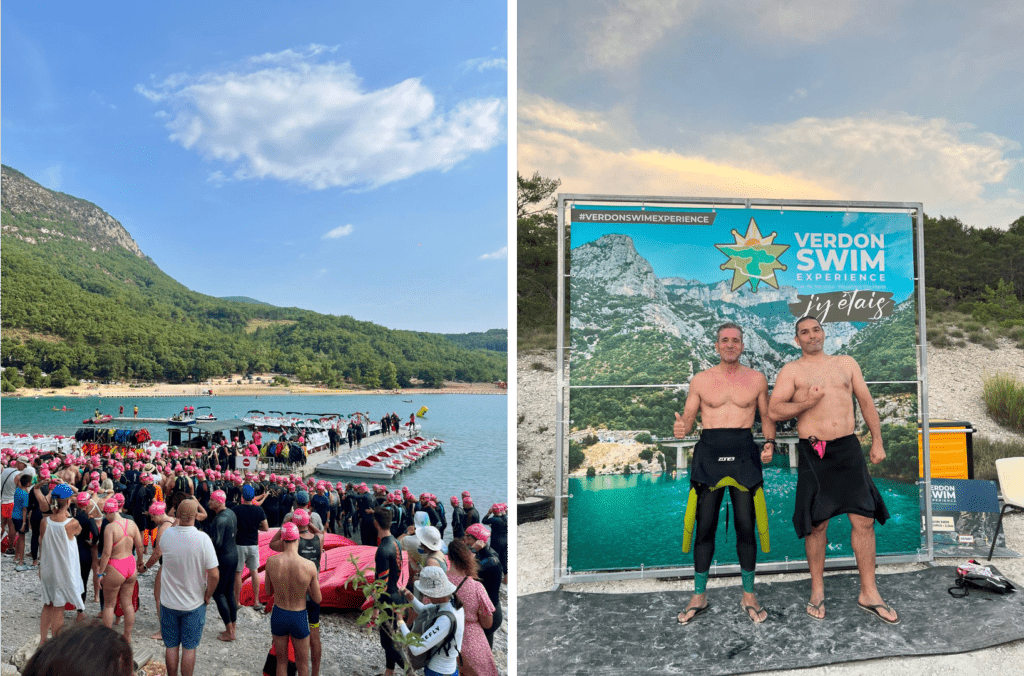
Next month, in September, it will be one year since I first heard about the “Verdon Swim Experience” through social media, announcing that registrations would open the following month. According to the organizers and the announcement, it is considered the most beautiful open-water race in Europe.
Naturally suspicious, and faced with such a bold claim, I decided to look into it further. And I was sold. I don’t know whether it is the most beautiful or not, but it takes place on a route with breathtaking views. In October, when registrations opened, I signed up for the 6K race without hesitation, and set myself the goal of finishing in under 2 hours (with no real basis, perhaps only that of sheer stupidity).
I started training from then on, both at the gym and swimming in the sea, but that preparation had to be temporarily interrupted due to a supraspinatus injury in both shoulders.
After that phase, that is, once I was discharged from physiotherapy, I discovered Swim4Fun, which helped me improve my technique and, as a result, reduce the likelihood of future injuries like the one I had already suffered (or worse ones). Perhaps this “discovery” came too late, since I was only three months away from the race.
Meanwhile, the race season began, and I took part in the Setúbal and Caxias events (I finished the 3K in 1h2m, which led me to believe the above target was attainable), as well as one stage of the Zêzere crossing and two events in the long training festival (4K and 6K). Essentially, I wanted to assess the “state of the art” regarding my shoulders. Although the physiotherapist, already in a post-discharge session, had firmly stated that there was no inflammation and that I was fit from the point of view of the joints and tendons, there was always a slight “ache,” especially during the first 600 meters each time I swam.
As time went on, that ache faded; I gained more confidence until the day of the trip to France arrived.
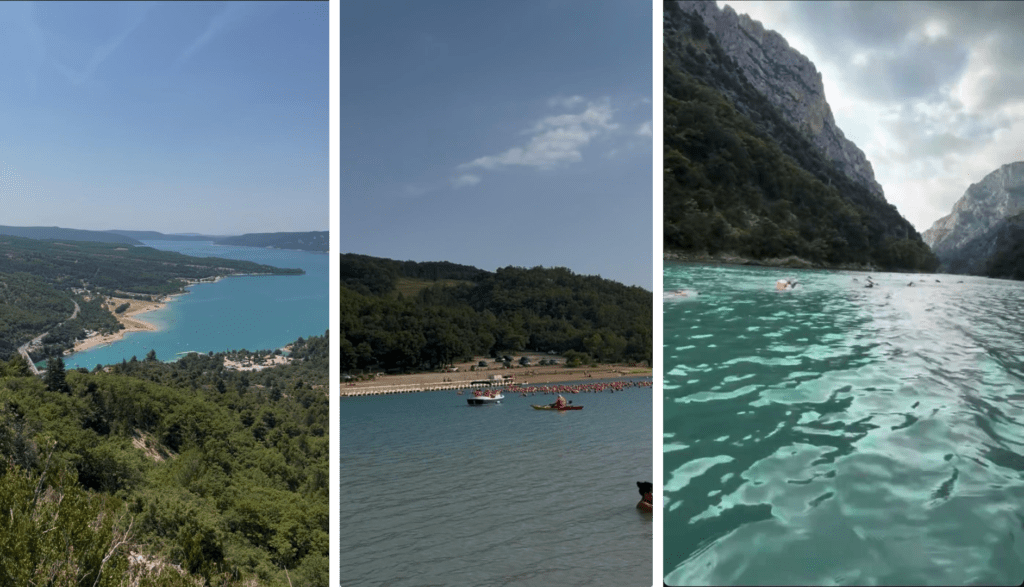
When I arrived at the race venue, the thoughts and emotions were overwhelming. All the promotional images corresponded exactly to what I was now seeing. An idyllic place, radiating immense tranquility. But as time passed and the start time approached, that tranquility faded. The prevailing thought was: “Can I do it? Will the pain come back? This is all very beautiful, but I won’t have the chance to take in the scenery!”
Then the time came! In my wave set (Saturday sunset, since there was also Saturday sunrise and Friday sunrise and sunset), we were about 600 participants, divided between the 3500-meter and 6000-meter races. In my 6000-meter race, we swam 2000 meters along the river, returned to the starting point, and finished with 2000 meters along the lake, with the finish line on another beach.
The start was in the water. Each participant went through a checkpoint to indicate their nationality. Having realized how this worked, I stayed in the middle. Even so, I spent more than ten minutes comfortably “treading water” with my arms and legs doing nothing. Once the start signal was given, the usual chaos began — elbows, tugs, feet hitting goggles in the first 200 meters — until we apparently began to settle down. I say apparently because, once we passed under the bridge, we entered the Verdon Gorge itself, where the course narrows dramatically. There, the breathtaking view was set aside and I went into full survival mode until the turnaround at 3500 meters. From there, the dynamic changed completely: far fewer people, it became autopilot mode, and I began swimming in a more contemplative way — though that did not mean the absence of challenges.
From 1200 meters onward, the water temperature suddenly dropped to 12 degrees, and at the turnaround (2K) it was 10 degrees. All I could think about was swimming faster to reach a section with more “normal” temperatures. Around that time, a group of about six athletes formed, creating a good cycling-style dynamic, where the “rabbit” took turns leading, and we overtook a significant number of athletes.
Around the 3K mark, still in the river but already with a cramp in the big toe of my right foot, I decided to take an energy chew. Since it took some time to swallow, even without stopping and while swimming on my back, I completely lost contact with the group. From then on, it was a solitary journey, and therefore more arduous. The saving grace was that, after 1 km, I entered the lake, where the temperature was already 21 degrees. Since I was already in warm water and felt that I had fallen behind, I decided not to take any more chews, which later proved to be a fatal mistake.
Around 4.3 km, another cramp. This time, more irritating, but still bearable — in the shin muscle (?!?! Always on the right side). I continued on, with my emotional and physical reserves running low, and around 5.2 km came the almost fatal blow — a paralyzing cramp in my right adductor. At that point, I had to go to the shore, sit on the rocks (extremely relaxing), and stretch in an attempt to ease it a little. Meanwhile, a member of the organization appeared out of nowhere on a SUP, asking me questions in French (which I imagine were to ask whether I was okay or wanted to give up. Just a side note — in the wave I took part in, I don’t know about the others, but almost half either withdrew or were disqualified). Half desperate, half angry, and in a provocative tone toward the man who came over to help me (poor guy, he only came to assist me), I took half a chew and put my legs back to work, because I was not going to quit over 800 meters.
“Putting my legs back to work” soon became “putting one leg back to work,” because the cramp returned. But my anger was so great that it did not stop me from finishing the race.
I finished, full of spasms, very happy, yet with mixed feelings, because my time was 2h19m. But seeing the sunset in that wonderful place made everything worthwhile.
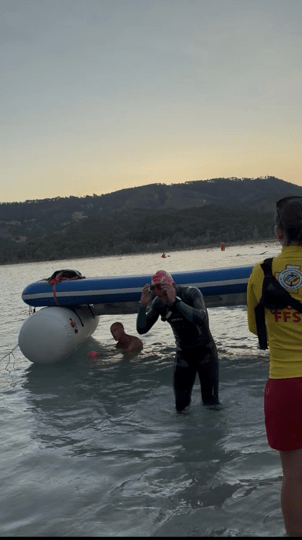
In The Divine Comedy, Dante writes that the road to paradise begins in Hell. I think that, in this case, it was a circular path: it began in Paradise, passed through Hell, and ended in Paradise.
Now it is time to start thinking about the list of paradises (hells) I want to do. One in particular I will only do when I am older and the Swim4Fun team helps me — the Bosphorus Cross-Continental Swim Race. But there are more, in the short and medium term.
Lessons learned:
- Gather as much information as possible: It is not enough to understand the route and the buoys around it. It is important to talk to other people who have done it before, in order to understand optimal routes, main challenges, and any other relevant information.
- Taking energy chews/liquids is essential: just as with food, we should not eat only when we are hungry; energy intake should not begin when cramp symptoms are already looming. From now on, in long races, every 50 minutes I will take something. And in gel form, because it is much faster. Chews never again.
- Keeping routines: for someone like me, who has certain routines (breakfasts, supplements, etc.), I think it is crucial to maintain them as much as possible; because there is one, perhaps the most important one, that is sure to change — rest, since we are not sleeping in our own bed, in our usual environment.
- Learning to tolerate pain: within certain limits, and in certain environments, pain can be part of the race and our companion. What I mean is that the body can endure more than we imagine, and therefore we should not give up at the first “uncomfortable” signs.
- Time must not be the cause, but the consequence: setting goals for ourselves is positive. Exogenous variables (water temperature, currents, wind, etc.) are so varied that setting a race goal becomes subjective. It almost turns into an act of psychological and emotional self-infliction, in addition to the physical strain we will go through. Especially when we start realizing, during the race, that we will no longer achieve it. The best thing is to make sure we do our best and, at the end, when we reach the finish line, look at the official times. Anxiety will only slow us down.
Tiago Leitão