
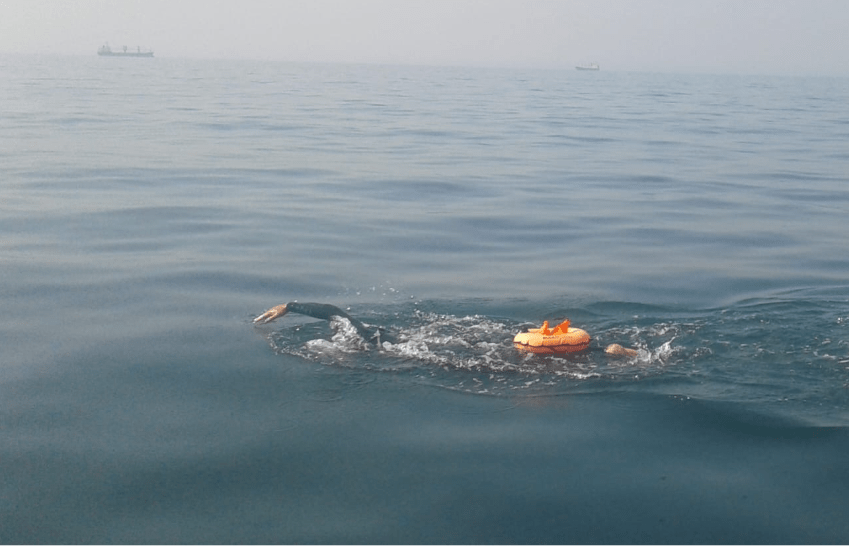
I like to swim long distances in training swims. 2hrs30-3hrs is perfect.
I believe I have nailed the perfect set-up for swimming self-supported with regards to fuelling (i.e. no kayak or boat support). To be honest, I prefer to do this even if there is support. Having run out of willing listeners for my advice, I’m broadening my outreach via this blog.
To be honest, I prefer to do this even if there is support. Having run out of willing listeners for my advice, I’m broadening my outreach via this blog.
First of all, you need a buoy that allows you to carry things that: a) doesn’t drop it all in the sea; and b) allows you to get things in and out easily. I’ve tried all sorts, but by far the best one is the buddy swim ‘hydrostation’ or donut. This has an inner pocket with a waterproof seal that allows you to keep things within reach and without getting wet. As below:
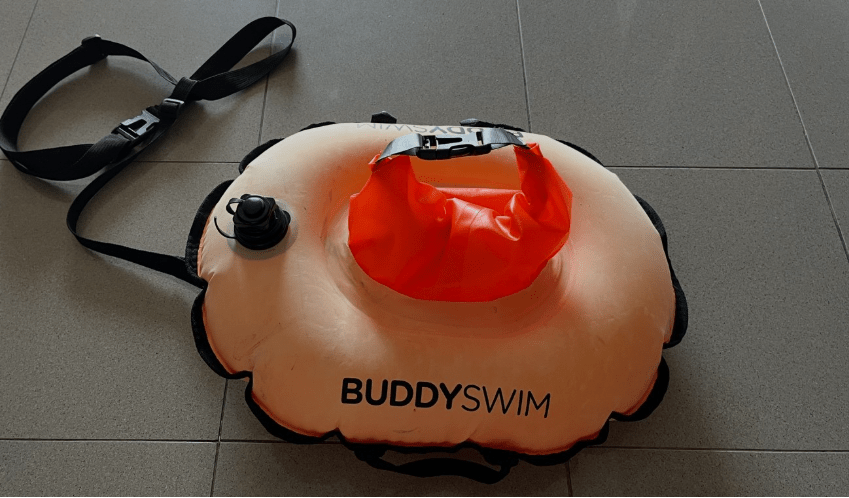
What does not work, are the big massive inflatables that you can’t really get into easily, or the ones with outside pockets, where you risk littering and losing your stuff.
Secondly, you need enough food and drink to last the duration in the water. There’s nothing worse than under-fuelling, bonking and having another hour to go.
I find what works best is to eat at least 80 grams of carbs and ideally drink about 400mls per hour. Of course, you can do more or less, or whatever you are used to, but this is what works for me.
I suggest gels, as no matter what you try, things end up getting wet or soggy. You might be tempted to take sweets, like gummy bears, but as soon as water gets on the inside it’s a sticky nasty mess.
You want everything clean and organised. No clingfilm, no ziplock bags. Gels also allow you to track the grams of carbs (if you are targeting a specific amount).
For example, if I am swimming about 2hrs30. I use gels with 40g carbs. So, I take a gel when I start, then I take a big one every 30 mins at: 0h, 30mins, 1hr, 1hr30 and 2hr (sometimes I’ll even have a small one at 2hr15). This is 5-6 gels.
Having so many gels in your swim buoy is not that straightforward, wrappers get muddled up with unopened gels, and you spend time rummaging around trying to find them in the buoy and make a mess of things. Hence, you need a system. Importantly, you never want to litter.
My system is to have an empty bottle that I use as a bin. Around it I have all the gels attached with an elastic band. I’m not saying this is the only way of doing it, but the best ones are the thick elastic bands that you get around asparagus. They are strong enough and the right size for a bottle. The set-up looks like this:
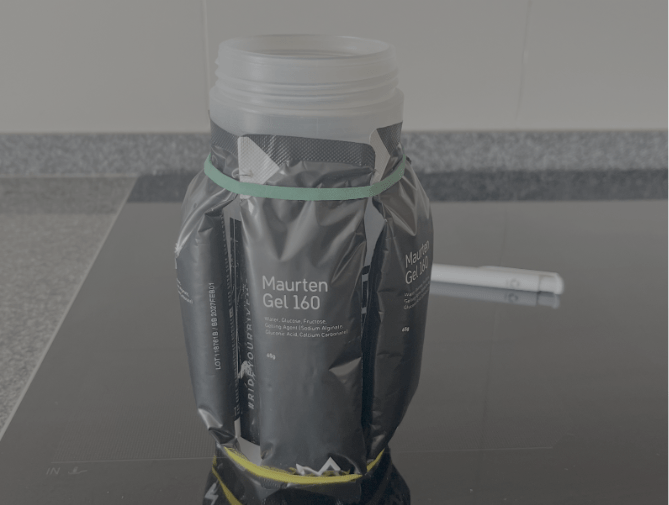
As you consume each gel, you then put the wrapper on the inside. Believe me, this is a game changer.
Se necessário, e se você estiver nadando com outras pessoas menos organizadas, também pode usar como lixeira para as embalagens de todo mundo. Você nunca quer que o lixo vá parar no mar.
Thirdly, you need to drink. Since you don’t need to make toilet stops as you would if running or on the bike, I think it’s good to have as much liquid as possible – ideally with electrolytes.
I find if you down a litre or more right before you enter the water, it more or less covers your first hour (also good: multiple coffees and an açai).
Then you just need another bottle for the next hour etc.
You have a few options. There are three options that I think work best. Firstly, one hard bottle.
This is the bog standard. It stands next to your ‘gel bin’, as shown below.
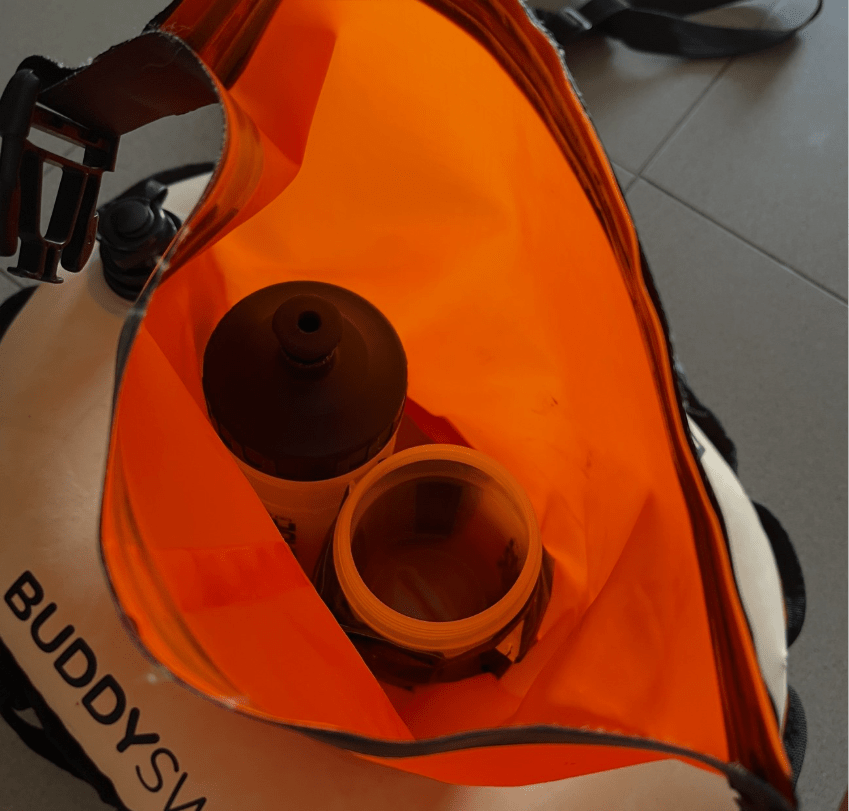
You only have space for one of these though, and don’t be tempted to replace the ‘gel bin’. Second, you can put some of those soft flasks along the side. These work well for a bit more capacity. Finally, you can consider a camelbak bladder on the base of the swim buoy.
All of this will add weight, so you need to make sure the swim buoy is at a length that it isn’t interfering with your swimming. I.e. not bashing into your legs etc.
Once you do this, you can then look down on your swimming counterparts and scoff as needed as they fill their swimming buoys with all sorts in a disorderly mess.
You can thank me later!
Ricard Horne
Excelentes dicas, Ricardo! Eu vinha pensando em como eu poderia montar um sistema assim, pois, até agora, eu não tinha sistema nenhum! Só tenho a bóia padrão, com bolsinho de rede externa, que não serve para os nados mais longos. Sua descrição detalhada de um sistema bem pensado e resultado de tentar várias formas e variações é muito bem vindo e vai me ajudar! Mais uma vez, obrigado!
Obrigada pela partilha! Quanto mais bem organizados entramos no mar, mas conseguimos curtir a experiência. Muito bom!